Five months cut from every very large crude carrier.
Nothing was replaced. Not the docks, not the cranes, not the workforce. What changed was the structure of the work, and with it, the pulse of the organization.
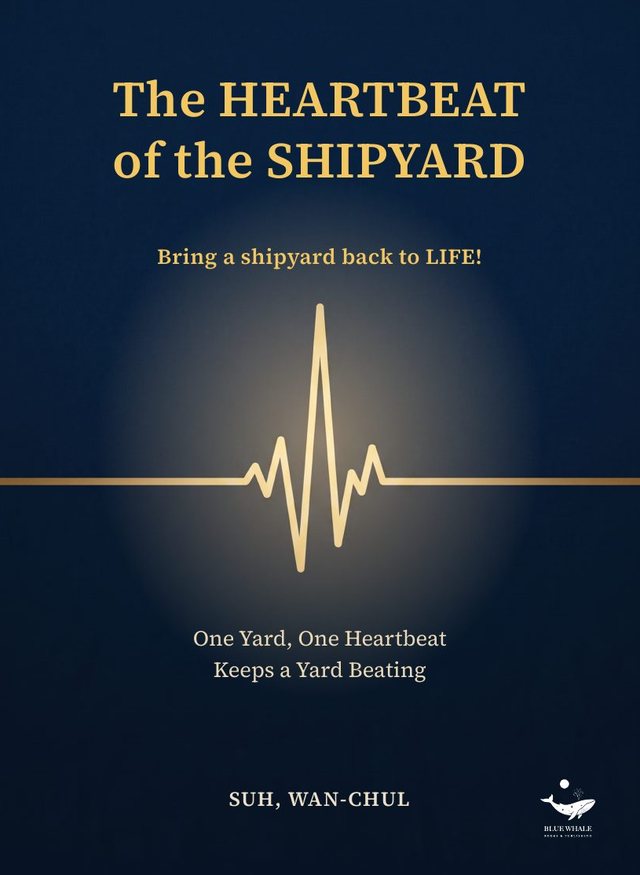
The Heartbeat of the Shipyard
by Suh, Wan-Chul
Okpo's rise was documented by Harvard Business School in 1994 (Case 9-695-001).
Five months cut from every very large crude carrier.
From about 1,300,000 to about 520,000 per VLCC.
The first single yard in history to hold it.
After eight years in which not one was delivered on time.
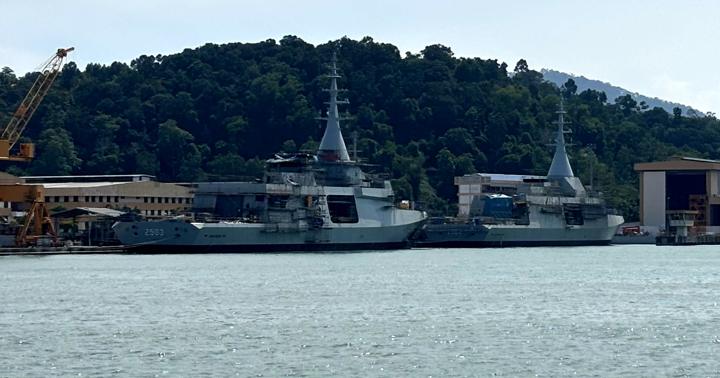
Boustead Naval Shipyard, the SLEP-2 corvette: outfit-installation progress against plan. Same drawings, same equipment, same workforce.
Redrawn from Figures 9 and 13 of the book. Curves traced from the original charts; figures in the notes are the book's own.
Behavior follows the path of least resistance. Durable change comes from building a structure in which the right behavior is the easy one.
Also: Prologue · Foreword by Jong Gye Shin · Preface · Epilogue · Appendix: A Look Ahead · References · About the Author

Daewoo Shipbuilding, Okpo, Korea · 1987–1993
There is no failure, only the failure to act.
Part II · SummaryBoustead Naval Shipyard, Malaysia · 2013–2017
The production system and the human system recover together or not at all.
Part III · SummaryThe template for any yard
The four wheels are a template to be adapted, not copied.
On every beat, every workstation hands its block to the next at the same moment. That beat is the book's first idea, and only the first wheel of the system beneath it.
After Figure 8 of the book: synchronized shipbuilding flow for a commercial large tanker at Okpo.
The four wheels of the book's operating system mesh in a closed ring: each turns only because the other three do. TACT drives on the yard's beat, the floor routines turn with their wheels, and the whole stands on one frame. Beneath it lies the ground the machine exists to bring to the surface: Ideal Reality. Select any part to read it.
“Can TACT, EPP, WORKOUT and Go-and-Check together call forth disciplined freedom, tight cohesion, learning organization and goal-directed immersion?” Ch. 16
The ratchet holds each gain: a permanent in-house training school (Ch. 18). What endures is what is faithfully transmitted.
How a yard its own nation had written off reached world leadership in six years, with the same docks, cranes and people.
How seven late naval MRO projects were followed by seven delivered on time, and how system integration fell from fourteen months to seven.
A working method you can use on Monday: TACT planning, the Ban Meeting, zone-based planning and the baton-touch.
The arc from Kaiser's yards and the NSRP to Synchronized TACT Production, and back to America's Maritime Action Plan.
Fifty years on the yard floor, told candidly, including where the method still fails.
This book is far more than a memoir. It is a valuable industrial chronicle that vividly records the hardships of the early shipyard-building era, the process of overcoming technological and experiential limitations, and the remarkable journey toward achieving world-leading productivity and competitiveness.
The true value of this book lies in the fact that it does not speak only of success. The author candidly recounts failures, setbacks, and trials, consistently emphasizing that genuine innovation stems not from technology alone, but from changes in people’s thinking and behavior, organizational culture, and management systems.
This book will serve as a living textbook for young engineering students, an inspiring guide for industrial leaders, and a source of insight for anyone seeking to understand the essence of innovation.
At its core, this book describes a low-investment, high-productivity technology that transforms shipyards. Yet the success of any intervention depends on the interior condition of the intervener.
As one of the many who have benefited from the author’s intervention, I cannot help but reflect on his attitude. He looks at a situation objectively, using the tools in this book, until the truth reveals itself and reality is exposed as it truly is.
This tectonic logic, in its truest sense, allows the intervener to prevent catastrophic project failures by moving away from “vanity metrics” and faked progress reports.
The technology instills TACT-based behaviour that brings all stakeholders into harmony, creating an unstoppable wave of high performance and behavioural change.

United States, now
The country that out-built the world in 1942 now builds less than 1 percent of its new commercial ships, and its Navy cannot get the warships it has already ordered on time.
In February 2026, America's Maritime Action Plan answered with investment in capacity, workforce and technology over a five- to ten-year horizon. That window is one or two ship programs long. There is no time to spend it learning, yard by yard, why new capacity does not move.
Under what operating conditions will those investments actually produce the productivity gains the plan envisions? The plan does not directly take it up. This book does.
“Capacity added without structure will not, on the historical record, drive.”
The capability American yards need is generally already present. What has been missing is the structure that lets it work.See the operating system →
A method that started in America, returning to America. It was built on the publications of the U.S. National Shipbuilding Research Program, themselves a refinement of what Henry Kaiser's yards proved at industrial scale in 1942.
How did South Korea do it? Beyond innovationKeynoteNational Symposium on Maritime Technology, Malaysia22 October 2018
Paradigm Change in Shipbuilding and Continuous ImprovementKeynoteInternational Technology & Innovation Symposium, MMET & UniKL15 May 2018
Sharing Experience on Transformation of ShipbuilderKeynote3rd National Maritime Industries Forum, AMIM, MIGHT & MIMA18 November 2014
Suh, Wan-Chul advises shipyards and industrial organizations through Proper Mediation Inc., Seoul.
propermediation@gmail.com+82 2 564 0700Seoul, Republic of KoreaAbout the book, a yard you are responsible for, or an invitation to speak. Questions are answered by email.