Commercial newbuilding · Korea · 1987–1993
Daewoo Okpo: from bankruptcy to the world's leading VLCC builder in six years
Nothing was replaced. Not the docks, not the cranes, not the workforce. What changed was the structure of the work.
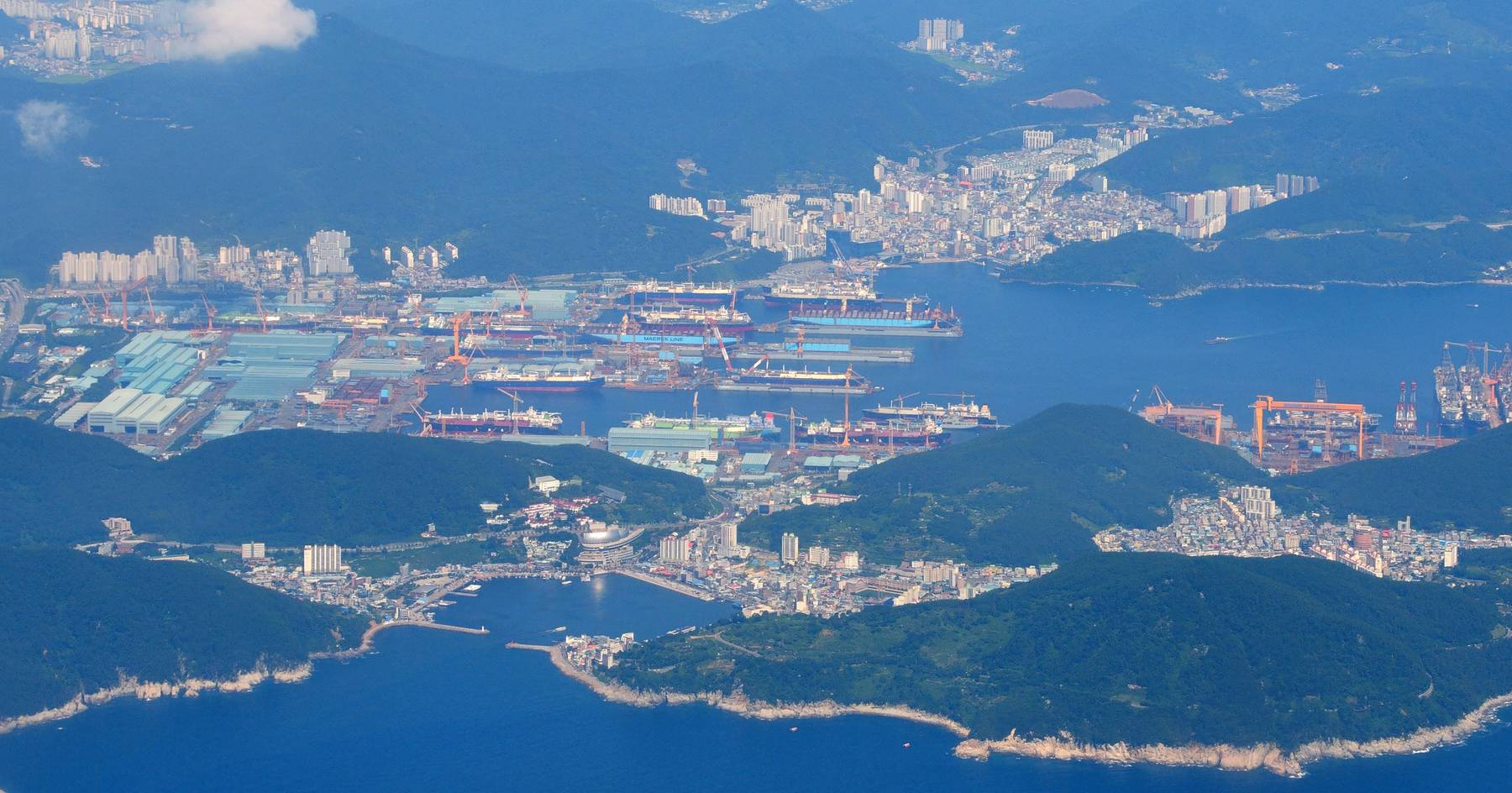
Photo: IikaJzuchiN, CC BY-SA 4.0, via Wikimedia Commons
- Daewoo Okpo
- Okpo, Geoje Island, Korea
- Very Large Crude Carriers
- Suh Wan-Chul, director of the Vision 90s turnaround programme
- Harvard Business School Case 9-695-001
The situation
A labour uprising in the summer of 1987 brought an already struggling yard to collapse. Its accumulated losses had passed the point from which most companies do not return, and the nation regarded it as a disgrace. The group chairman moved his residence to the small town of Okpo and announced he would lead the recovery from the front.
The panel-block shop had been designed to flow and had not flowed for three years. Its six-month plan was a masterpiece on paper. Asked one morning which was the two-hundredth block on the plan, the planner could not say. Nor the hundredth, nor the thirtieth.
What changed, in order
1988–1989
The panel-block shop: one visible beat
Planners on the floor at seven each morning with the foremen. A four-hour TACT across six workstations. Within weeks every block moved in sequence, and a foreman could see five days ahead on one sheet of paper.
Late 1980s
The curved-block shop: four streams into one
The head of detailed design was moved to run the shop. Teams wrote down their own work procedures for the first time, and four feeder lines were tuned to deliver one finished curved block a day.
1990–1991
Total optimum and grand modulization
"The shop heads must not be selfish. They must think of the whole." The VLCC was re-divided for the whole yard, and dock work moved upstream into a grand-module factory.
1992
One yard, one beat
Twenty-six workstations across five manufacturing levels, from piece parts to sea trial, kept the same rhythm under one engineering, procurement and production framework.
Curved-block shop · TACT 1 day
Minor assembly · 1-day
→ 1 / day
Plate joining · 2-day
→ 1 / day
Flat panel · 3-day
→ 1 / day
Curved panel · 5-day
→ 1 / day
Block assembly · 9-day
→ 1 curved block / day
The people: building ships is building people
Before any method could be installed, the order of the workplace had to be restored. The investment in people came before, and alongside, every technical change.
10,000+employees, and many of their families, through a year of Family Training
4,000+workers trained in profit-making IE, ending with Work Sampling at their own station
3 monthsof training for every foreman in the yard, away from the floor
4,000+workers sent to see Japanese yards for themselves
Keep time. Keep clean. Greet first. Use refined words. Keep your post. Do not loiter.
The six disciplines, posted at every gate and recited at every Ban Meeting.
Results
| Indicator | Before, 1987–88 | By 1993 |
|---|---|---|
| VLCC lead time | 14 months | 9 months |
| Man-hours per VLCC | 1,300,000 | 520,000 |
| Dock cycle per ship | 12 weeks | 8 weeks |
| Idle workforce in the dock | 33% | 0% |
| Lost-time accidents | Far from negligible | Zero |
| Share of world commercial tonnage | Near collapse | 10% |
Design for production in the same period cut the number of blocks by half, scaffolding by 60 percent and cable length by 23 percent.
What lasted
≈ 20%of the world VLCC market, held cumulatively for three decades
139 of 759VLCCs in the world fleet in April 2019 were built at Okpo, the largest share of any single yard
“The point of the work was the music it had become able to play.”